
WEARABLE HEALTH TECHNOLOGY • 2026 IN-DEPTH REVIEW
The World’s Most Trusted Health Computer on Your Wrist
How a device that started as a fashion statement became the most clinically significant consumer health tool ever made.
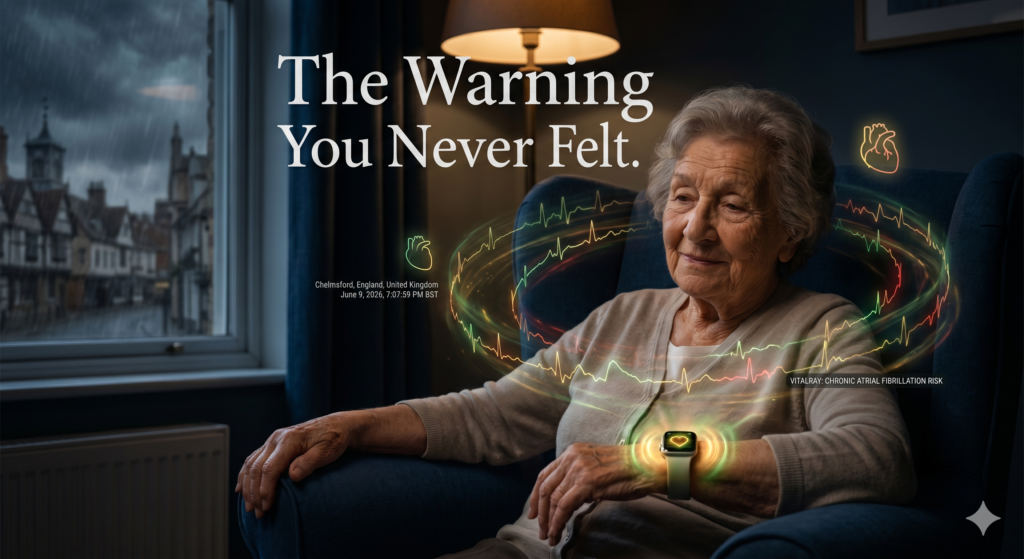
There is a moment that Apple executives love to talk about — not in earnings calls, but in the kind of quiet conversations that reveal what a company genuinely believes it is for. It is the story of the stranger in the airport, or the runner by the lake, or the grandmother in Ohio, who tapped their Apple Watch, saw a notification they did not understand, showed it to a doctor, and was told: you almost just had a stroke.
These stories are not marketing. They are documented. And there are thousands of them.
Since its launch in 2015, the Apple Watch has undergone a transformation so complete that calling it a “smartwatch” today feels almost reductive. It is a continuous health monitoring platform, a clinical-grade cardiac tool, a sleep laboratory, a stress barometer, and — as of 2026 — an AI-powered personal health coach, all compressed into something you can wear to a dinner party without anyone noticing it is quietly saving your life.
“92% of smartwatch users use their device specifically for health-tracking activities — a figure that would have seemed absurd in 2015.”
The Engine Room: What Is Actually Inside Your Apple Watch
Most people have no idea what is packed into the small disc of glass and aluminum they snap onto their wrist each morning. The sensor array inside a modern Apple Watch would have filled an entire medical examination room just twenty years ago.
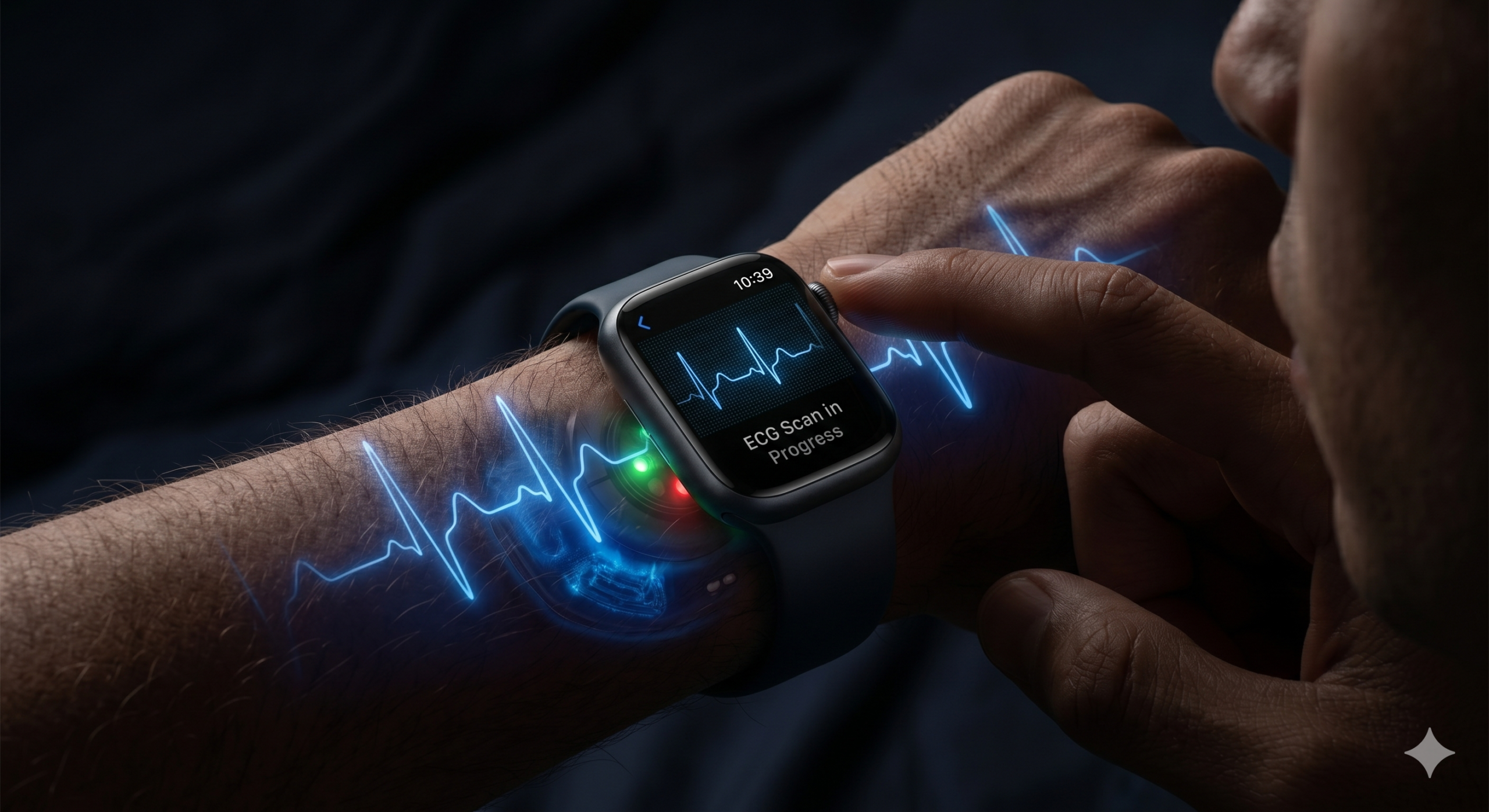
The optical heart sensor uses both green and infrared LEDs to detect blood flow through the skin, measuring your heart rate continuously throughout the day. The electrical heart sensor — the one that powers the ECG feature — uses electrodes built into the Digital Crown and the back crystal, turning your body into part of the circuit. When you place your finger on the Crown, you complete a loop and the watch records a single-lead electrocardiogram in just 30 seconds.
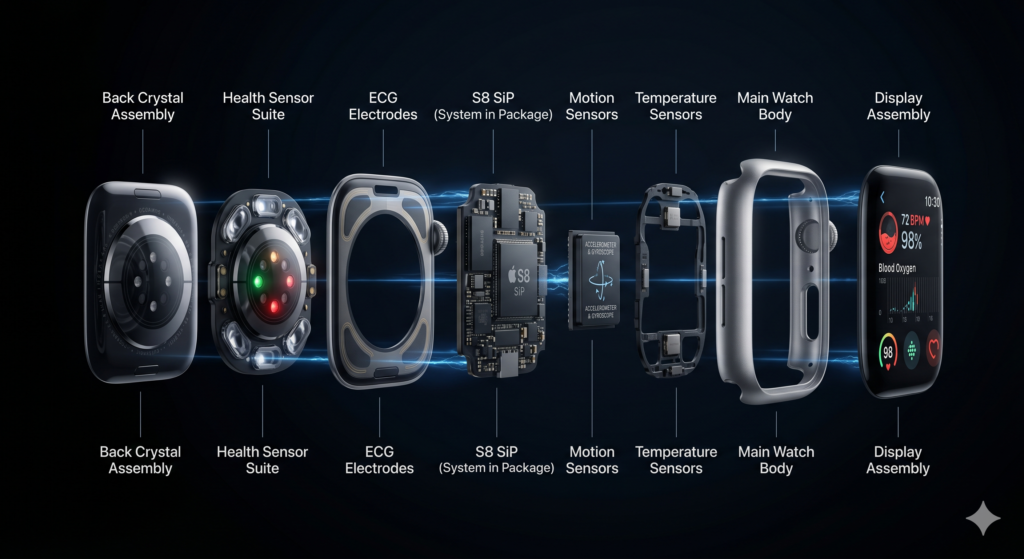
Then there is the blood oxygen sensor, the skin temperature sensor (introduced on the Series 8 and measuring overnight variations as small as fractions of a degree Celsius), the barometric altimeter, the accelerometer, and the gyroscope. Together, these sensors generate a stream of biometric data so rich that researchers have used Apple Watch data in studies covering over 10 million participants worldwide.
The hardware is remarkable. But the real intelligence lives in the software layered on top of it.
The Heart of the Matter: AFib, Hypertension, and Saving Lives
No single Apple Watch feature has had more documented medical impact than its atrial fibrillation detection. Atrial fibrillation — AFib — is an irregular heart rhythm that affects an estimated 59 million people worldwide. It often produces no symptoms whatsoever. Left undetected, it dramatically raises the risk of stroke and heart failure. For decades, diagnosing it required either a Holter monitor worn for 24 to 48 hours, or the luck of being in a doctor’s office during an episode.
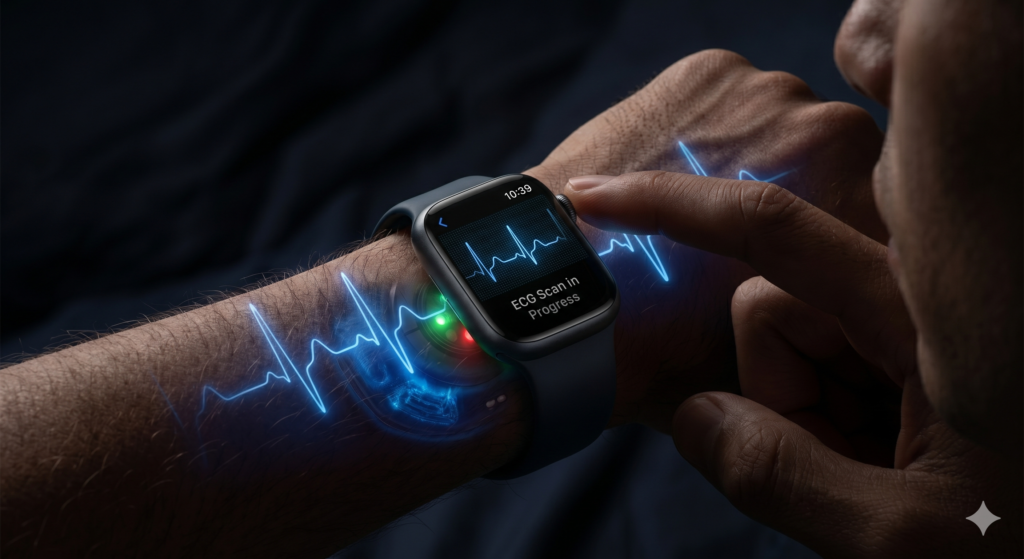
The Apple Watch changed that equation entirely. Its FDA-cleared ECG app can generate a medical-grade single-lead electrocardiogram on demand, anywhere, at any time. The irregular rhythm notification feature runs in the background continuously, alerting users when it detects a heart pattern suggestive of AFib even when they are not actively checking. Cardiologists have described receiving patients who walked in waving their watch notifications — patients who had no idea anything was wrong with their heart.
In 2025, Apple took its cardiac ambitions further still with the introduction of hypertension notifications in watchOS 26. Rather than measuring blood pressure directly, the system analyzes heart sensor data over a rolling 30-day window, using machine learning to identify patterns consistent with chronic high blood pressure. It is available on Series 9 and newer models. Now, in 2026, Apple has submitted an even more advanced blood pressure detection system to the FDA — one that may eventually offer direct blood pressure measurement, a capability that would mark a genuine first for any consumer smartwatch.
“When you can see in precise data that a decision you made affected your heart for the entire night, abstract health advice becomes personally undeniable.”
Sleep: The Metric That Changed Everything
If the Apple Watch’s cardiac features are its most medically dramatic capability, its sleep tracking may be its most personally transformative one. Sleep, for most of human history, was something that simply happened to you. You lay down. Time passed. You woke up. Whether that time was restorative or destructive was largely a mystery.
Apple Watch sleep tracking gives that mystery a number. Wearing the watch to bed, it measures your time in each sleep stage — REM, core, and deep sleep — using a combination of heart rate patterns, movement data, and respiratory rate. The Vitals app displays your overnight metrics each morning: heart rate, respiratory rate, wrist temperature, blood oxygen, and sleep duration, all compared against your personal baseline range.
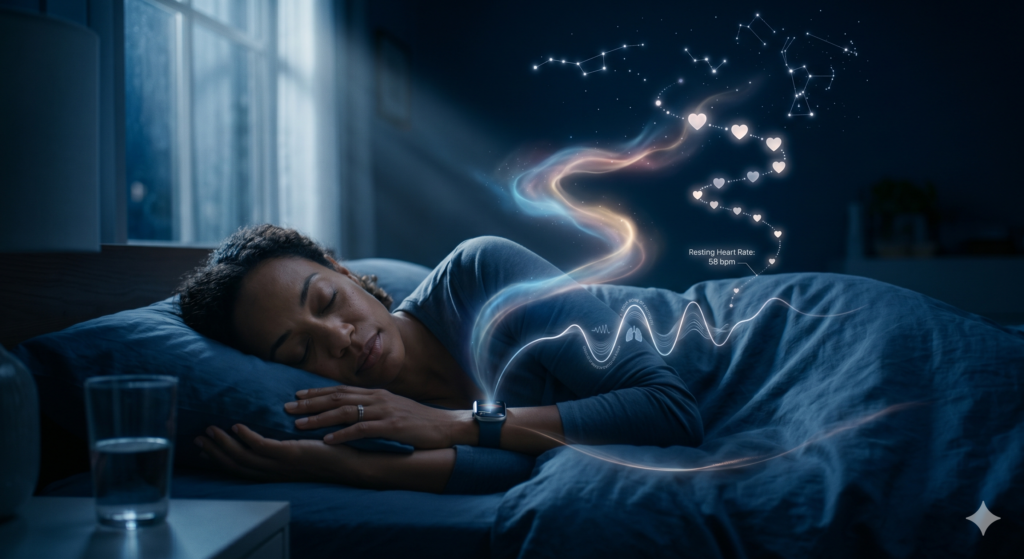
What makes this meaningful is not the data itself but what people do with it. When users see concretely that a late coffee pushed their sleep onset back by 45 minutes, or that a glass of wine elevated their resting heart rate and cut their deep sleep nearly in half, behavior changes in a way that generic advice never achieves. The data makes the connection personal, immediate, and undeniable.
In 2026, Apple is developing advanced sleep tracking algorithms with greater stage accuracy, alongside new stress detection tools that alert users in real time when physiological stress markers spike — closing the feedback loop between what your body is experiencing and what you can actually do about it.
2026: The AI Health Agent Arrives
Perhaps the most significant shift coming to the Apple Watch ecosystem in 2026 is not a new sensor — it is a new intelligence. Apple is preparing a major redesign of its Health app, scheduled for iOS 26.4, that would fundamentally transform it from a passive data repository into what insiders are calling an active health coach.

Central to this transformation is a native nutrition tracker that would allow users to log meals and track macronutrients directly within the Health app — ending Apple’s decade-long reliance on third-party integrations. But the headline feature is an AI-powered Health Agent that leverages the neural engine built into both the iPhone and Apple Watch to analyze a user’s complete biometric picture and offer personalized, actionable lifestyle recommendations.
This is not a chatbot. It is a system that knows your resting heart rate trends, your sleep quality patterns, your activity levels, your stress signatures, your menstrual cycle data, and your heart rate variability history — and uses all of it together to give advice that is genuinely tailored to you, not to a statistical average of people vaguely like you. It is the closest thing to having a personal physician who has been silently observing your body for years.
The Privacy Question Apple Cannot Escape
Apple has long staked its brand on privacy, and nowhere is that promise more consequential than in health data. Your Apple Watch knows things about your body that your employer, insurer, and government would find extraordinarily valuable — and extraordinarily dangerous in the wrong hands.
Apple’s architecture stores health data locally on-device by default, encrypted in a way that Apple itself cannot access. Health data synced to iCloud is end-to-end encrypted. The Health app requires explicit user permission before any data is shared with third-party apps. These are meaningful protections, and they matter.
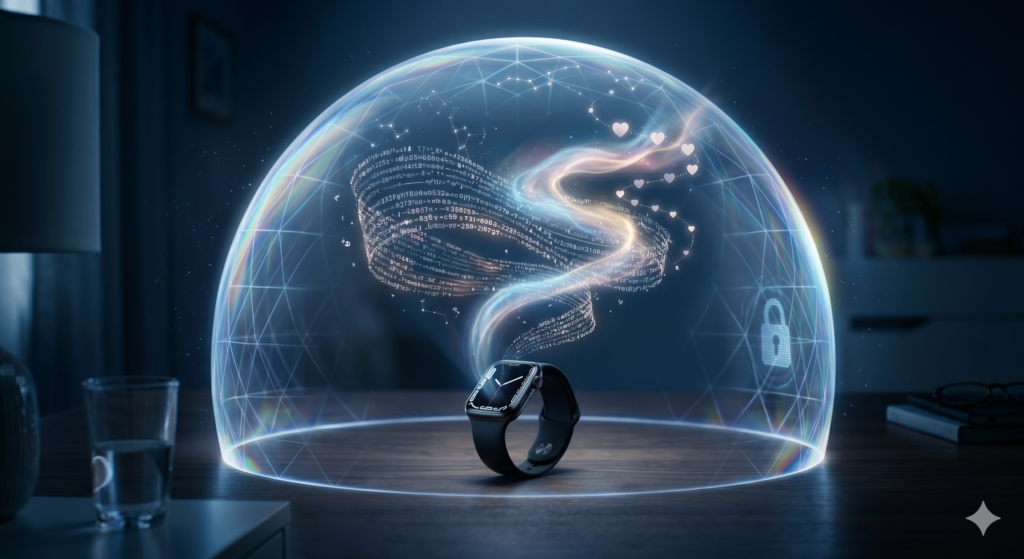
But the questions remain serious. As the Health Agent becomes more sophisticated and more cloud-dependent, what happens to that analysis data? As Apple explores health insurance partnerships and premium subscription tiers, where do the incentives point? In 2026, 42% of consumers say privacy practices now directly influence which wearable they purchase — up from just 18% five years ago. Apple knows this. It is, for now, a company that has earned significant trust on this front. Keeping that trust will require continued vigilance as the health data it collects becomes ever more intimate and ever more valuable.
The Verdict: More Than a Watch
The Apple Watch in 2026 is the most sophisticated health monitoring tool ever sold to a general consumer audience. It has earned FDA clearances, changed cardiology workflows, been cited in peer-reviewed research, and quietly altered the health trajectories of people who had no idea they needed help.
It is not perfect. Its ECG is a single-lead, not a twelve-lead. Its blood oxygen readings are not yet validated for clinical use in all contexts. Its sleep staging, while impressively accurate, is not yet a substitute for a clinical sleep study. And like all wearables, it is only as good as the person willing to wear it consistently.
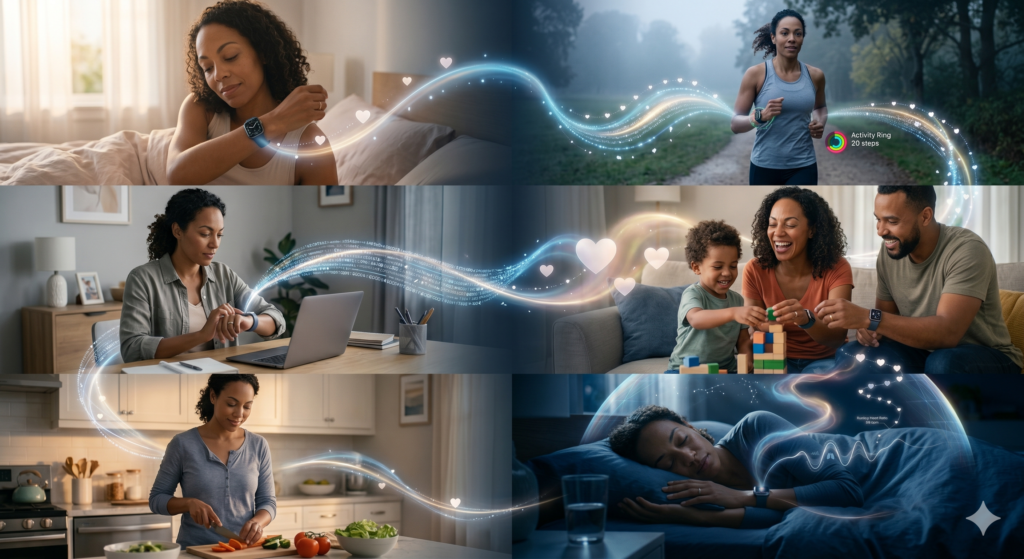
But here is the truth that every cardiologist, sleep researcher, and preventive medicine specialist will quietly admit: the best health monitoring tool is the one people actually use. And hundreds of millions of people use their Apple Watch every single day — wearing it to sleep, wearing it to the gym, wearing it to dinner, wearing it, in other words, through the full continuous arc of their lives.
That is the revolution. Not the sensors. Not the algorithms. The fact that for the first time in history, medical-grade health monitoring has become something people choose to wear because it looks good on their wrist.